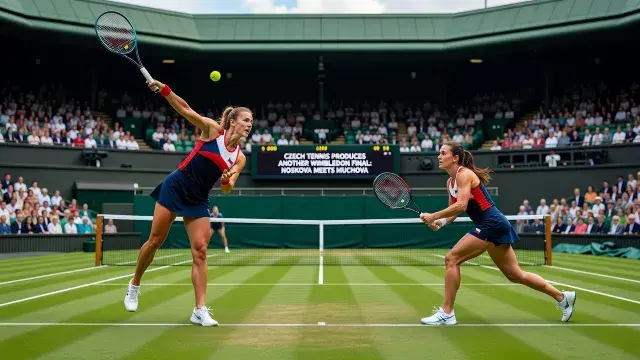
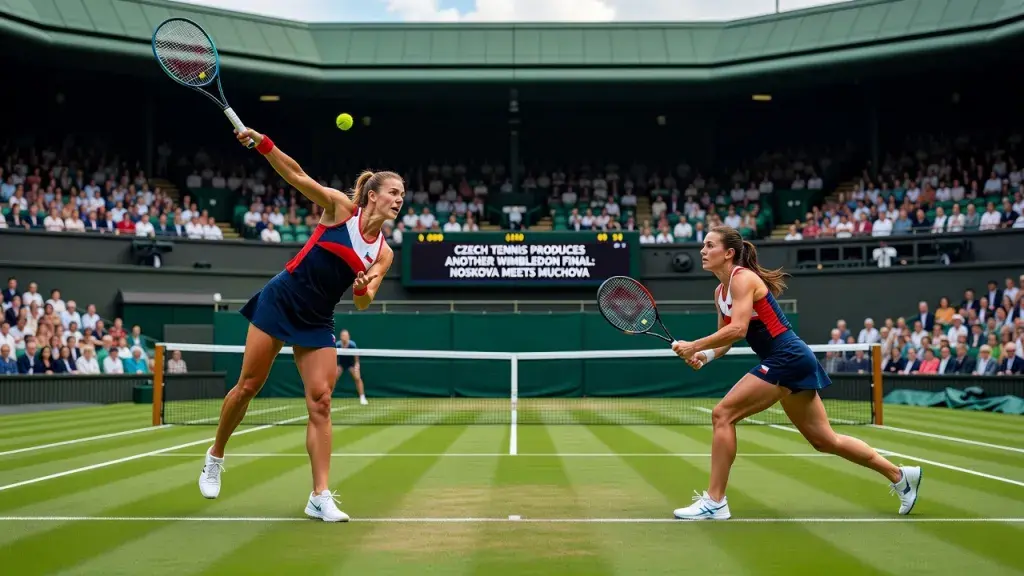
For the third time in as many years, a Czech woman will be crowned Wimbledon champion. Linda Noskova and Karolina Muchova have set up an all-Czech women's final at the All England Club, a result that would have felt extraordinary a generation ago but now seems almost inevitable given the staggering depth of talent this central European nation of just over ten million people continues to produce. The match represents more than a Grand Slam final - it is a statement about a sporting culture that has quietly built the most consistent tennis production line on the planet.
When Noskova appeared on 6-Love-6, the BBC Radio 5 Live phone-in hosted by John McEnroe, fresh from her semi-final victory, she laughed off the question with a quip about the magic properties of Czech beer - to McEnroe's obvious delight. But once the laughter settled, she offered something more substantive. She said she believes she can win because she has watched so many players from her country do exactly that, and the thought that follows is instinctive: why not me? That sense of expectation, almost of entitlement in the most positive sense, is itself a product of the system. Fans following the tournament closely across platforms, including SapphireBet, will have noticed that Czech women's tennis has become a recurring story at the Slams, not a fluke. Either Noskova or Muchova will become the third Czech winner of the Wimbledon women's title in four years, following Marketa Vondrousova in 2023 and Barbora Krejcikova in 2024.
The lineage stretches back further than that recent run. Both finalists cited Petra Kvitova - a two-time Wimbledon champion in 2011 and 2014 - as a formative inspiration. Jana Novotna and Jan Kodes won here too, and Czech-born Martina Navratilova, competing under the American flag, claimed nine Wimbledon singles titles. What this history does, according to Noskova herself, is normalise excellence. The Czech players see Grand Slam success not as a distant dream reserved for the exceptional few but as a realistic destination within a well-signposted journey. That belief is structural, not accidental. The Czech system gives every player, regardless of financial background or upbringing, access to a racquet and a court. Crucially, it also retains its former professionals - top-100 players, Grand Slam champions alike - within the sport as coaches. The result is an extraordinary depth of technical knowledge at every level of the pathway, with coaches who understand precisely what separates a good player from a great one because they have lived it themselves.
Muchova's Experience Against Noskova's Power: A Final of Contrasting Weapons
The tactical contest on Saturday promises to be genuinely compelling. Karolina Muchova, 29, is one of the most inventive players on the women's tour. Her game is built on slice, craft, and an ability to disrupt rhythm - she sees angles other players do not and is comfortable constructing points rather than simply trading blows. But she is no pushover in a baseline exchange either, as she demonstrated against Coco Gauff in the semi-finals. When Gauff raised the intensity in the second set and tried to bully Muchova off the baseline, Muchova responded by moving further inside the baseline in the third - pressing, not retreating. That competitive reflex will matter enormously against Noskova.
Muchova also carries the advantage of Grand Slam final experience. She played in the French Open final in 2023, losing to Iga Swiatek at Roland Garros, and that exposure to the specific weight of a major final - the sleepless night before, the nerves during the warm-up, the crowd, the occasion - is something you simply cannot simulate. She will know better this time how to compartmentalise those emotions and stay within her process. There is a widespread sense among close observers of the game that Muchova's career might have yielded even more without the serious injuries that have interrupted her momentum repeatedly. When fit, her level is elite. She appears healthy and sharp this fortnight, which is a significant factor in itself.
Noskova, meanwhile, is a different proposition entirely. At 21, she has long carried the label of future champion, having become the youngest player inside the world's top 100 back in 2022. This Wimbledon has been the moment she has shown that potential is ready to be converted. Standing at 5ft 10in - taller than the television camera tends to suggest - she generates enormous natural power through long levers, producing a massive serve and a ball that sits heavy on an opponent's strings. But what makes her truly dangerous is the drop shot she hides in the same motion. Madison Keys, who Noskova dispatched in the fourth round, observed that when Noskova has time on the ball, opponents cannot commit in either direction - moving back behind the baseline to deal with pace leaves them exposed to the drop, but stepping in invites the full force of a driven winner. You genuinely cannot defend both options at once.
Friends, Former Doubles Partners, and Mutual Experts
There is one further layer to this final that sets it apart from most: Noskova and Muchova know each other extremely well. They were doubles partners at the 2024 Paris Olympics, they have practised together countless times, and they even shared Centre Court in the build-up to their respective semi-finals this week. Yet this familiarity is unlikely to be a distraction for either player, precisely because it is so unremarkable within the Czech tennis environment. There are enough compatriots on tour that playing a fellow Czech is part of the routine. The flip side of that familiarity, of course, is that both women will walk onto Centre Court with an unusually precise map of the opponent's game - the preferred patterns, the second-serve tendencies, the under-pressure habits. Tactical preparation, as a result, will be unusually specific on both sides of the net.
Whoever executes their gameplan more cleanly will lift the title. Noskova needs to dominate with her serve and dictate the pace before Muchova can impose her creative chaos. Muchova needs to disrupt Noskova's rhythm early and force her to play the kind of scrambled, improvised tennis that suits the older Czech far more than it suits the younger. It is a final with a clear tactical architecture - and the result will almost certainly hinge on which player imposes her own terms in the biggest moments. Either way, Czech tennis adds another chapter to a story that is becoming one of the defining narratives of the modern Grand Slam era.