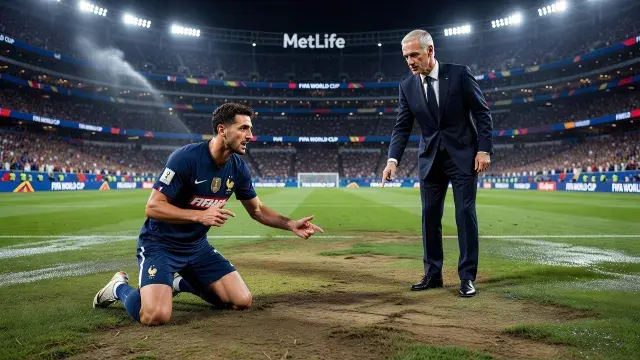
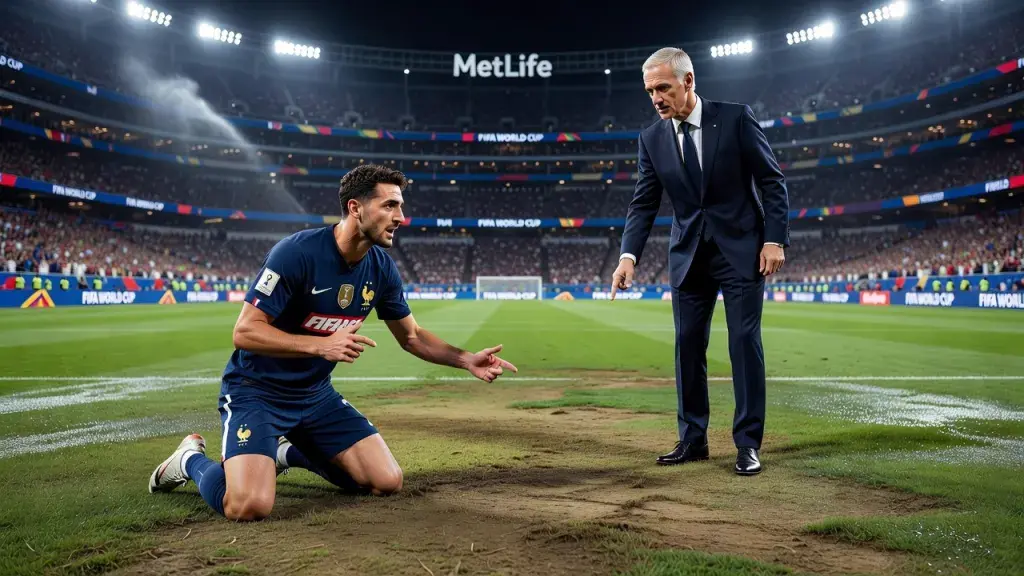
Adrien Rabiot did not mince his words after France's victory over Senegal at MetLife Stadium. The AC Milan midfielder questioned whether the playing surface deserved to be called a pitch at all, describing it as "quite hard and quite rigid" and likening it to an artificial surface. His manager, Didier Deschamps, was similarly unimpressed, suggesting there was "probably concrete underneath" with "very short fibers" - language that, coming from the coach of one of the world's most powerful football nations, carries considerable weight at a tournament of this magnitude.
France are not alone in their frustration. Brazil's Vinicius Junior raised comparable concerns when the Seleção opened their 2026 campaign against Morocco at the very same venue, noting how the heat "dries out" the surface and hampers the team's ability to find their rhythm. The complaints speak to a broader tension at this World Cup: a tournament hosted primarily across NFL stadiums, seven of which - MetLife included - ordinarily operate on synthetic turf. Much like a lacrosse bet placed on a field sport contested on an unfamiliar surface, the players here are dealing with conditions that fall well outside their usual professional environment, and the performances - and frustrations - reflect that. A temporary natural grass pitch has been installed at MetLife specifically for the World Cup, meeting FIFA's mandatory requirement for natural surfaces, but the underlying infrastructure of an NFL venue is not easily disguised.
Pitch maintenance has been a visible operation throughout the tournament. Watering at halftime has become routine to combat dryness, though the system is not without its own complications. At Gillette Stadium, during Norway's win against Iraq, a malfunctioning sprinkler forced ground staff to shut down all sprinklers simultaneously to prevent damage, before manually dispersing excess water from the affected area prior to the restart. FIFA measures moisture levels, surface firmness, and ball roll daily at MetLife Stadium as part of its monitoring programme - a sign that the governing body is aware of the scrutiny these surfaces are under, even if players feel the checks are not translating into satisfactory conditions on matchday.
A Problem With Precedent
The complaints from Rabiot and Vinicius are not without historical backing. After last summer's Club World Cup - whose final was also staged at MetLife Stadium - Chelsea captain Reece James described the American pitches he had experienced as "not so good" relative to European standards. "There's astro underneath and maybe grass on top," James said. "It's not the best for the body, for the joints, for the muscles." That tournament served, in retrospect, as something of a dress rehearsal for these exact concerns. The warning signs were there.
The issue has a longer, more contentious backstory. When Canada hosted the 2015 Women's World Cup, nearly 50 players filed a gender discrimination lawsuit against FIFA, furious at being required to compete on artificial surfaces that their male counterparts would never have been asked to play on. The then-FIFA secretary general Jérôme Valcke defended the decision by suggesting that artificial pitches would eventually host the men's World Cup too. That prediction has not materialised. FIFA subsequently directed prospective hosts for the 2023 Women's World Cup away from synthetic venues, and today mandates that fixtures at both the men's and women's World Cups must be played on natural grass - even when, as is the case across much of the United States, the stadiums involved were never built with that in mind.
The Broader Stakes for European Teams in America
There is a wider context to France's discomfort that extends beyond the turf. European nations have historically struggled to translate their continental dominance to World Cups held outside Europe. It was not until 2010 - in South Africa - that a European side first lifted the trophy on foreign soil, with Spain claiming that landmark. Germany followed in Brazil four years later. In every other World Cup played outside Europe, the winners have come from South America: Uruguay twice, Brazil four times across four different continents, Argentina in 1978, 1986, and 2022. If France are to break through this cycle on North American soil, dealing with unfamiliar conditions is part of the challenge - and the pitch, apparently, is just the beginning of it.