
Choosing a higher-paying opportunity in a more prominent arena over an existing contract is not unusual in professional life — but when the two commitments belong to competing organisations operating on overlapping schedules, the consequences can be severe. Zimbabwean fast bowler Blessing Muzarabani made precisely that kind of choice when he opted to participate in the Indian Premier League rather than honour his commitment to the Pakistan Super League, and the PSL's response — a two-year ban — has ignited a wider conversation about the economics of franchise cricket and where its centre of gravity truly lies.
A Collision of Calendars Forces a Difficult Choice
For the first time in considerable memory, the PSL and IPL schedules have run concurrently, placing contracted participants in the uncomfortable position of choosing one over the other. The IPL, backed by the Board of Control for Cricket in India and drawing from one of the world's largest and wealthiest domestic markets, commands a financial scale that few comparable competitions can approach. The PSL, while a credible and growing franchise competition in its own right, operates in a structurally different economic environment.
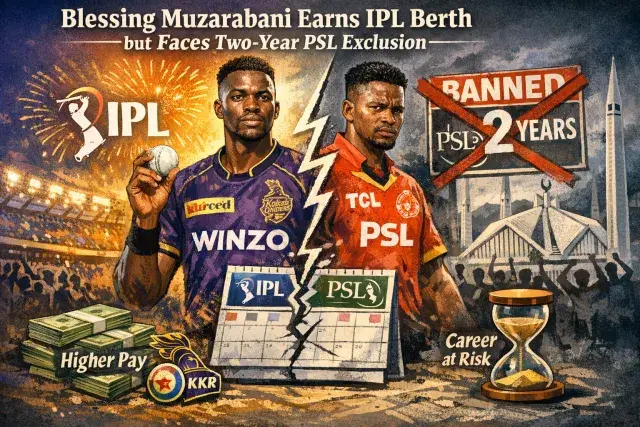
Muzarabani's own contract figures make the calculation stark. Kolkata Knight Riders secured him as a replacement signing for 75 lakh Indian rupees. His PSL contract with Islamabad United was valued at 11 million Pakistani rupees — approximately 36.44 lakh Indian rupees at current exchange rates. The IPL offer represented roughly double the financial return. For a professional whose earning window is finite and whose international visibility depends substantially on the company he keeps, the decision carried clear rational logic.
The Broader Pattern Behind an Individual Decision
Muzarabani was not alone in this calculus. Several overseas participants made the same choice when the scheduling conflict became apparent, reflecting a structural reality that PSL organisers and Cricket Pakistan will need to reckon with seriously. The IPL functions not merely as a revenue source but as a visibility platform — performance there reaches audiences and decision-makers in ways that few other competitions replicate. For a bowler from Zimbabwe, where domestic infrastructure and international exposure remain limited compared to the subcontinent's giants, the opportunity to perform in front of the IPL's global audience carries value that goes beyond any single contract fee.
Muzarabani justified the choice on the field as well. Performing with consistent impact for Kolkata Knight Riders, including taking four wickets in a single outing against Sunrisers Hyderabad, he demonstrated exactly the kind of form that builds international reputation. His profile heading into subsequent international cycles — including future ICC events — is materially stronger for having competed at that level and delivered.
The PSL's Ban: Enforcement or Overreach?
The PSL's decision to impose a two-year exclusion on Muzarabani is, in contractual terms, a defensible response. Competitions rely on the integrity of their rosters. When participants exit for more lucrative alternatives, it weakens the product, creates logistical disruption, and — if left unaddressed — signals that PSL contracts carry limited binding force. From the competition's institutional perspective, acting firmly sets a precedent.
Yet the penalty has generated genuine debate, and not without reason. A two-year ban is a significant sanction for a professional whose active career years are limited. Critics argue that the punishment places the burden entirely on the individual rather than addressing the scheduling conflict that created the dilemma in the first place. If the PSL's calendar had not overlapped with the IPL's, no such choice would have arisen. The administrative failure, in this reading, belongs to the governing bodies — not solely to the participant who responded to circumstances he did not create.
What This Episode Reveals About Franchise Cricket's Hierarchy
The Muzarabani situation is instructive precisely because it is not exceptional. It reflects a structural tension that will recur as long as the world's dominant franchise competition commands compensation and exposure that other competitions cannot match. The question for smaller competitions is not simply how to penalise participants who leave — it is how to build financial and institutional credibility sufficient to make staying the more compelling option.
For players from nations with fewer resources and less international exposure, the IPL represents something that no punitive clause can easily counterbalance: the chance to be seen, paid well, and positioned favourably for future opportunity. Until that underlying asymmetry changes, scheduling conflicts will keep producing versions of the same choice — and the same debate.