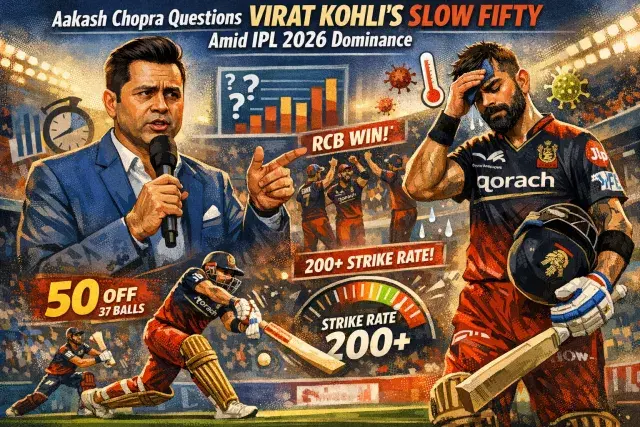
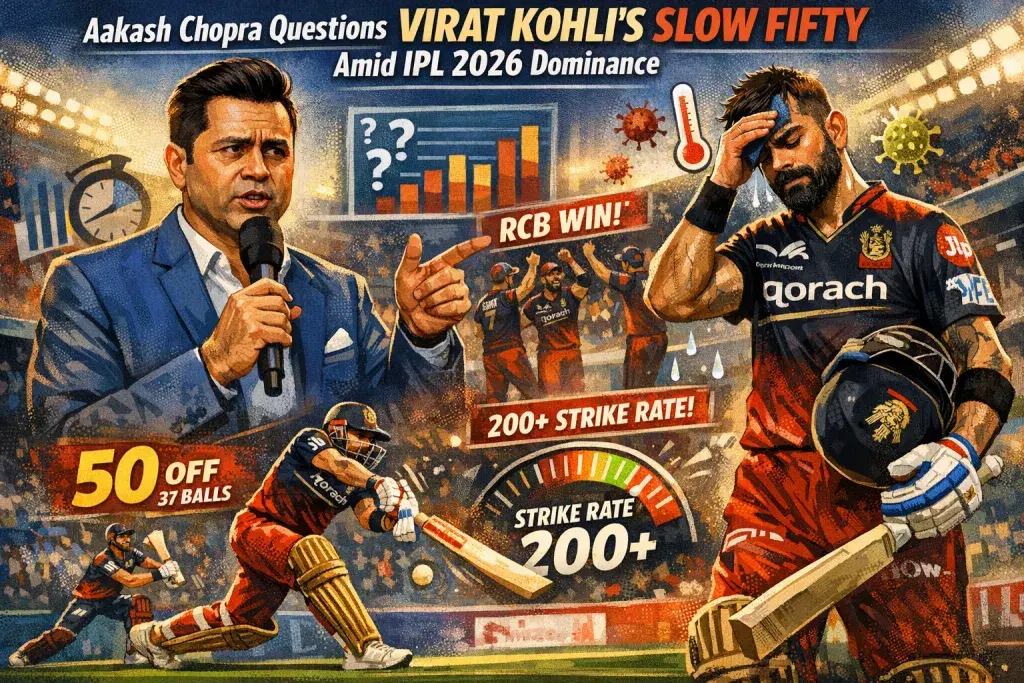
Virat Kohli completed a half-century off 37 deliveries against Mumbai Indians while every other RCB batter in the same innings operated at a strike rate above 200 — a contrast sharp enough to draw pointed public criticism from commentator Aakash Chopra. The knock raised a familiar debate: when does individual underperformance matter if the collective result is a win? The answer, at least from a cricketing standards perspective, is more complicated than a scoreboard suggests.
What Chopra Said — and Why It Carries Weight
Aakash Chopra, one of the more analytically rigorous voices in Indian cricket commentary, did not mince his words. "Virat Kohli actually scored very slow runs," he said. "If you look at it in the context of the match, you feel it doesn't matter as you won. But if you see it from the cricketing lens, it was a very slow knock. This kind of knock is unbecoming of the contest, and neither is it becoming of Virat."
The distinction Chopra draws — between match outcome and cricketing quality — is a meaningful one. Winning can obscure individual inefficiency. In the shortest format of the format, where every delivery carries compounding value, a batter occupying the crease at a sub-150 strike rate during a phase where the rest of the batting unit is accelerating at twice that rate creates a structural imbalance. Resources — in terms of balls available — get consumed without proportional returns. The fact that RCB still won comfortably speaks to the collective firepower around Kohli, not to the quality of his own contribution in isolation.
The Health Factor Changes the Calculation
Context, however, demands a fair hearing. Kohli reportedly entered this fixture carrying a high fever and a headache. He did not take the field during the opposition's innings, a meaningful signal about his physical condition at the time. Performing under physical duress changes the nature of what a batter can reasonably produce. Reflexes slow. Decision-making under pressure becomes less instinctive. The body's capacity to generate explosive movement — the kind required to consistently clear the boundary or manipulate field placements — diminishes noticeably when compromised by illness.
That Kohli chose to bat at all in that condition, and still reached fifty, is a detail that deserves acknowledgment even within a critical framing. The criticism is legitimate on technical grounds. But stripping it entirely of health context would be incomplete analysis, not rigorous analysis.
The Broader Picture: Kohli's Strike Rate Trajectory in 2026
What gives this conversation more texture is where Kohli actually stands in IPL 2026 relative to his own history. He has maintained a strike rate of 162 across this season — a figure higher than what he has recorded in previous IPL editions. That improvement is not cosmetic. It reflects a deliberate shift in approach that Kohli himself has spoken about publicly over recent years: a willingness to be more aggressive earlier in an innings, to back himself against pace in the powerplay, and to treat boundary-hitting as a priority rather than a consequence.
The knock against Mumbai Indians was an outlier within a broader pattern of more assertive batting this season. One below-par performance — delivered, it should be acknowledged, through genuine illness — does not erase a sustained pattern of improvement. Critics who use a single data point to build a sweeping conclusion are working against the evidence the season itself provides.
Standards, Expectations, and the Weight of Legacy
Part of what makes Kohli such a recurring subject of scrutiny is the standard he himself established. When a batter builds a reputation for excellence over nearly two decades, every deviation from that standard becomes magnified. That is the burden of sustained greatness: the bar does not lower with age or circumstance. Chopra's criticism is, in a sense, the compliment buried inside a critique — it assumes a level of execution that few batters in world cricket are expected to meet.
The more useful question going forward is not whether one slow knock defines Kohli's current ability, but whether the pattern holds. If the strike rate of 162 continues through the remainder of IPL 2026, and if performances under full health remain aggressive and impactful, the Mumbai Indians knock will settle into a footnote — the night a compromised batter still crossed fifty and won. If the sluggishness recurs without physical excuse, the conversation will justifiably deepen.