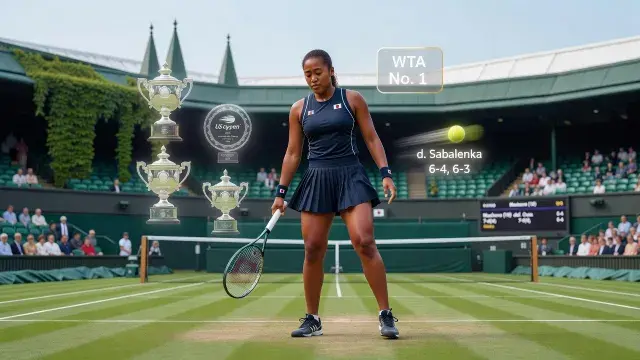
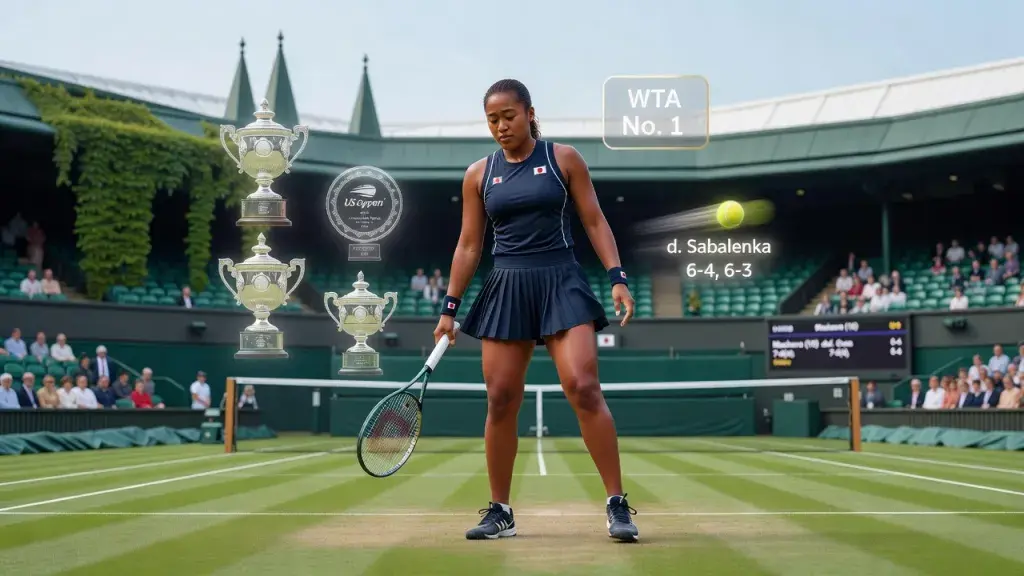
Naomi Osaka insists her Grand Slam ambitions remain very much alive, even as another promising run at a major ended in frustration on Tuesday. The four-time champion was beaten 7-6(4), 6-4 by Czech 10th seed Karolina Muchova in the Wimbledon quarter-finals, a defeat that stings not because of how far she fell, but because of how close she came to going further.
The result marks the latest in a string of late-stage major disappointments for Osaka, whose best years at the top of the women's game still feel recent enough to measure the distance. Just days earlier she had beaten world number one Aryna Sabalenka in the last 16 - a result that briefly reminded the sport of what Osaka, at her sharpest, is still capable of delivering. Across the sporting world this week, ambition has been meeting reality in different ways: in South African football, for instance, orlando pirates signings have signalled a club intent on closing the gap to domestic rivals, the kind of purposeful rebuilding that Osaka herself appears to be undergoing on tour. Tuesday's loss to Muchova, however, showed how quickly momentum can evaporate even when belief is genuine.
"I know my results don't show it, but whenever I play a Slam, my intention is to win," Osaka said in her post-match press conference. The candour was characteristic - Osaka has never been one to offer polished deflection when the honest answer is more revealing. She acknowledged that last year's US Open semi-final defeat to Amanda Anisimova left her desperate to reach a final, but she reserved sharper feeling for Tuesday. "This one is a little more upsetting to me because I feel like there was so much more I could have done," she said. "I feel like in my head I think there's still an opportunity to win a Slam."
A Career Interrupted, A Return Still Unfinished
Context matters here. Osaka's last Grand Slam title came at the 2021 Australian Open - her fourth major in fewer than three years, a run that placed her at number one in the world and established her as one of the defining players of her generation. What followed was a period of significant personal difficulty: a public withdrawal from competition to protect her mental health, extended absences from the tour, and then a full year away in 2023 after giving birth to her first child. The Osaka who walked onto the grass at the All England Club this fortnight was not the same player who dominated the hard courts of Melbourne and New York between 2018 and 2021 - but she is visibly closer to that version of herself than at any point in the intervening years.
She had never previously progressed beyond the third round at Wimbledon, which makes this quarter-final run a genuine personal milestone at a surface that has historically exposed her limitations. A first appearance in the last 16 at Roland Garros last month was another quiet data point in the same story. The trajectory is upward. The execution, as Tuesday showed, remains inconsistent. "I played so well in my last match, then today I just feel like I didn't play well at all and I didn't have any energy," she admitted. "The score was pretty good for what it was, I guess."
Hard Courts Beckon - and With Them, Real Opportunity
Where Osaka goes from here is the more interesting question. All seven of her WTA titles have come on hard courts, and all four of her Grand Slams - two Australian Opens, two US Opens - were won on that surface. The North American hard-court swing now looms, and it is the part of the season in which Osaka has historically been most dangerous. The US Open, in particular, remains a tournament where she has twice lifted the trophy and has reached the semi-finals as recently as last year.
There will be pressure on her to translate the promising signs of this grass-court campaign into something more concrete when conditions favour her most. She is 28, no longer the wunderkind who announced herself at Indian Wells in 2018, but still young enough and talented enough for a fifth major to be a realistic, rather than sentimental, aspiration. The question is whether the mental clarity and physical consistency that defined her peak years can be reassembled - fully, not just in flashes - before the window narrows further. If Wimbledon 2025 told us anything, it is that the talent is still present. The work, by her own admission, is not finished.