Congress Challenges NFL Antitrust Shield as Goodell Skips Judiciary Hearing
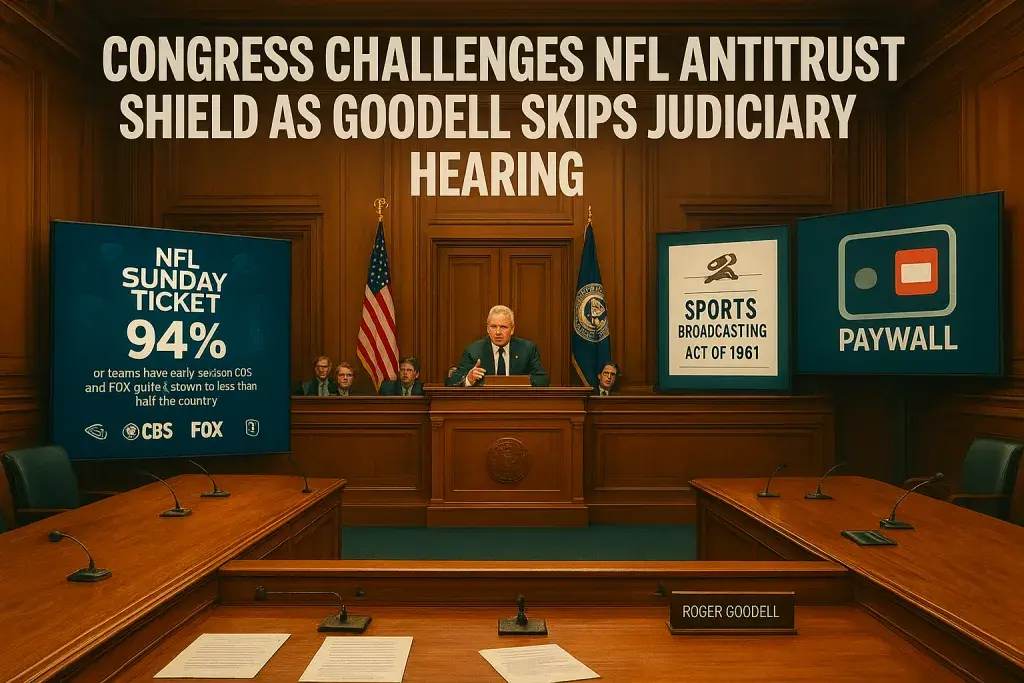
The House Judiciary Committee convened a hearing to examine whether major professional sports leagues, and the NFL in particular, are operating beyond the boundaries of the antitrust protections granted by the Sports Broadcasting Act of 1961 by moving games behind paid streaming services. NFL Commissioner Roger Goodell declined an invitation to testify, and the league sent no representative in his place. The NFL did not respond to requests for comment following the hearing.
The two-hour session produced an unusual degree of bipartisan agreement. Republican and Democratic committee members largely aligned in their concerns, and the witnesses called to testify were uniformly critical of the leagues' broadcast practices. Judiciary Subcommittee on Administrative State, Regulatory Reform and Antitrust Chairman Rep. Scott Fitzgerald (R-Wis.) argued in his opening statement that the Sports Broadcasting Act's antitrust exemption was granted on the condition that leagues maximize public access to games through sponsored telecasting, and that the leagues have failed to honor that condition. "Sports fans are paying the price because of it," Fitzgerald said.
Fitzgerald also challenged the NFL's public claim that 100 percent of its local market games are available free over the air and that 87 percent of games carry primary distribution on broadcast television. He presented material from the NFL Sunday Ticket's own marketing, which warns prospective subscribers that in the season's first month, 94 percent of teams have games on CBS and Fox that are shown to less than half the country - a statement Fitzgerald argued directly undercuts the league's position before the committee.
Curtis LeGeyt, president and CEO of the National Association of Broadcasters, told the committee his organization was not seeking repeal of the Sports Broadcasting Act but was asking lawmakers to enforce the guardrails the Act was designed to provide. "It is not meant to enable sports to be hidden behind paywalls," LeGeyt said, adding that the law was being "misused." OutKick founder and Fox News contributor Clay Travis urged the committee to evaluate the issue from the perspective of "the reasonable sports fan" and cited a specific example: Bills fans in Rochester and Syracuse, New York, whose tax dollars are contributing to Buffalo's new $2.2 billion stadium, will be required to hold a paid streaming subscription to watch the team's first game at that facility on Sept. 17, 2026, against the Detroit Lions - a Thursday Night Football broadcast not available free over the air outside the Buffalo television market. New York state taxpayers are contributing $600 million to the stadium's construction, with Erie County providing an additional $200 million.
With no NFL representative present to respond to any of the testimony or to argue the league's case, the hearing proceeded without rebuttal on any of the central charges. The committee's scrutiny arrives as a streaming platform has been announced as the exclusive commercial provider for NFL Sunday Ticket beginning with the 2026 season. Whether the hearing produces legislation, a formal committee report, or further proceedings has not been determined, but the absence of the NFL from its own consequential debate on Capitol Hill leaves the league without a public record of defense on the antitrust questions now formally before Congress.